Mad Priest has put up an excellent piece about employment discrimination in the Churches, including the CofE, from today's "Guardian" newspaper.
My comment? About bloody time too.
Tuesday, 24 November 2009


Don't blame me ...
... this came from a person in the parish ...
LET'S JUST SEE IF I'VE GOT THIS RIGHT
IF YOU CROSS THE NORTH KOREAN BORDER ILLEGALLY YOU GET 12 YEARS HARD LABOUR.
IF YOU CROSS THE IRANIAN BORDER ILLEGALLY YOU ARE DETAINED INDEFINITELY.
IF YOU CROSS THE AFGHAN BORDER ILLEGALLY, YOU GET SHOT.
IF YOU CROSS THE SAUDI ARABIAN BORDER ILLEGALLY YOU WILL BE JAILED.
IF YOU CROSS THE CHINESE BORDER ILLEGALLY YOU MAY NEVER BE HEARD FROM AGAIN.
IF YOU CROSS THE VENEZUELAN BORDER ILLEGALLY YOU WILL BE BRANDED A SPY AND YOUR FATE WILL BE SEALED.
IF YOU CROSS THE CUBAN BORDER ILLEGALLY YOU WILL BE THROWN INTO POLITICAL PRISON TO ROT.
IF YOU CROSS THE U.K.BORDER ILLEGALLY (AND AVOID DETENTION), YOU CAN FIND A JOB (SOMETIMES IN A POLITICIAN'S HOME), GET STATE BENEFITS, A DRIVING LICENSE, NHS HEALTH CARE, CREDIT CARDS, SUBSIDIZED RENT OR A LOAN TO BUY A HOUSE, AND FREE EDUCATION FOR YOUR CHILDREN.
Friday, 20 November 2009
A breathing space
This morning I received a letter from our Diocesan Bishop informing me that for the present no new appointments are being made for clergy to have their biennial review of their ministry with a Bishop or Archdeacon as the system is changing from "Episcopal Review" to "Ministerial Development Review".
Our Bishop writes: I do hope that the changeover can be achieved as smoothly as possible. Not least because Episcopal Review was taken up universally.
This is not quite the case. Clergy didn't have an option of refusing a review, or at least I was never told that we did. The letter would arrive telling me that my Review had been booked for such and such a date, and I was expected to be there.
If I'm honest about it, I learnt very swiftly to keep quiet in these interviews about what I see as my weaknesses, as they are pounced on and written into the report that goes into my file. I'm afraid if the church wishes to use management techniques such as this to replace the informal chats over coffee or tea when the archdeacon or bishop drops round (HA!), then I can't be blamed for playing the game along with them.
And when the letter comes with my next Review date, I shall dutifully go along.
Tuesday, 17 November 2009
Sunshine after the storm
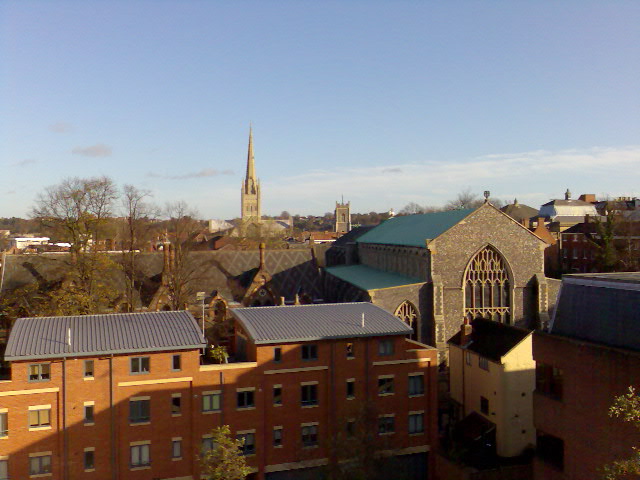
Norwich today was brilliantly sunny, and after my short swim I had a very nice light lunch in Cafe Rouge.
Friday, 13 November 2009
Enough about me, already!
The wind is rising, and occasional moaning noises are coming from behind the curtains in my sitting room. I think it's the windows, but I'm not looking to find out!
Oh to be in Brighton, now the storm is here ....

Oh to be in Brighton, now the storm is here ....

Ow!

Well, it's not a frozen shoulder, but a hefty inflammation of the rotator cuff, and so my normally dour Doctor stuck a needle into my left shoulder four times with a mixture of local anaesthetic and cortisone. I also have some tablets to take with food, one twice a day, which may have indegestion as a side-effect! I'll look forward to that then. Got a smile from the doc again though (which is a major triumph) as he used a naughty word when he saw how inflamed it was, and I said that was the sort of language I'd been using as well!
Came home and have slept for four hours! I have already been offered a lift to church on Sunday morning as one of the problems is that I find it very painful to lean forward and change gear. Have never wanted an automatic, but in this instance it could be useful.
Just wish I had a firm chest like that in the picture!
Thursday, 12 November 2009
He may have been on to something

We know that the physical body decays, and I have a fairly practical outlook on that. It won't last, and our Christian faith tells us that something better awaits, but Dr. Frankenstein's approach to spare-part replacement seems quite attractive as the years advance and parts of the body start to protest. On and off my lower back has caused me problems since the mid-80's, and for the last 4 years it's aggravated the sciatic nerve in my right leg, which can make simply walking uncomfortable. Nine weeks ago the right side of my jaw decided to feel as if it was dislocating every time I opened my mouth. Unfortunately for my congregations it didn't stop me climbing up into the pulpit and delivering 10 minutes of blather every Sunday. That coupled itself with an inflamed inner ear canal which seems to have sorted itself out - almost. Then last Saturday afternoon my left shoulder began to ache. It was better on Tuesday, but yesterday it got progressively worse through the day. This morning I can hardly lift that arm above my chest, which made dressing an interesting challenge. So, it's another appointment with the Dr. who will probably look at me, ask the symptoms, and then say, "Yes I've had that as well. I've no idea what it is. Take two aspirins." Heigh Ho.
Wednesday, 11 November 2009
Tuesday, 3 November 2009
That was wonderful!

Another triumph in the supper kitchen, and this time I only took a photo after I'd eaten it!
Chicken breast wrapped in smoked bacon and cooked in white wine, served with roast winter vegetables and herbs (onion, potato, parsnip and carrot). The cooking sauce was very salty from the bacon so that was not used, but the chicken was served with a tablespoon of creme fraiche on top.
And there's some left for tomorrow!
What is the point?

I get my copy of the Church Times a week late, as I am number 3 in a line of 4 that read it, so I have only just seen its coverage of the Pope's invitation to disaffected Anglicans. In a small box at the bottom of a page there are a series of questions and answers about aspects of this invitation to the dance, and four of them put everything into perspective.
Does this mean that Rome now recognises Anglican orders?
No.
Will former Anglicans need to be rebaptised?
No, but they will be reconfirmed.
Will people then be Roman Catholics?
Yes, everyone who belongs to a Personal Ordinariate will be a Roman Catholic.
Will they still be in communion with Canterbury?
No.
So, let's think about this for a moment. Rome doesn't recognise Anglican orders, so who the hell do they think they are talking to when they meet with Roaming ap Williams? And why should they give a tinker's cuss what he thinks? This sort of highlights the "special relationship" that's going on, and shows the love affair between the travelling Tufti and Papa to be a little one-sided.
Then there's the reconfirmation issue, neccessary since the Anglican one was done by a non-recognised bishop. Well, excuse me Your Holiness, but you can stuff that one right up your pontifical crown.
And as to the next point ... oh look, surprise surprise, we all become Roman Catholics. So much for holding on to an Anglican identity in the Ordinariate. The article also mentions elsewhere that any liturgy that the former Anglican congregations wish to use has to come from books approved by the Vatican. Anyone want to lay bets on how much of our heritage will be found wanting?
And then there's the point that the Ordinariates will not be in communion with Canterbury, which sort of brings us round in a circle to the first issue of Anglican orders.
Sorry guys, but I just don't see what's changed from the usual practice of conversion to Rome apart from the fact that this way whole church communities can do it. For individuals the traditional route remains.
Maybe we ought to be promoting the fact that the Church of England has a form of Reception for disaffected Roman Catholics. The travel is a two-way street, and coming in this direction no reconfirmation is needed.

Saturday, 31 October 2009
It be a dank dark night out there ...
... with all manner of things abroad in the shadows. It be just the right time for a tale of strange a-doings in the urban jungle.
It all began last Sunday evening with a journey to "The Cock" in Sussex where I partook of a rather succulent trencher of steak and ale pie, accompanied by vegetables and a merry company.

All too soon I had to leave the comfort of this last homely house and head for the salt-air of the coast. There I found queer lodgings and the next day I made my way to a small one-storey place of entertainment where the food was good, the ale flowed freely, and tales were told.
On the Tuesday I was driven in a carriage without horses to the metropolis, and found welcome in sumptuous surroundings. The scent of moth-balls and oil paint greeted my nostrils, and faces captured in a moment of time looked down upon me.

I left this opulence for a while, finding hot beverage in the nearby Gloucester Road, and gazing with some longing at the delicacies displayed in the window of the patisserie next door.


That evening, sustenance was taken in a Moroccan tavern,

and I ate lamb and couscous and drank liberally of their red grape libation.
Wednesday saw me venture forth into the city, and I visited the grand Library where I was reminded of the lost treasures of Alexandria. Leather-bound volumes stretched from floor to ceiling, and in another dimly-lit room, precious and ancient illuminated manuscripts were open to viewing.

From there a fair wind took me to a vast national treasury where I gazed upon great monuments from Egypt and Greece.


An open-air market was found in the grounds of St James's church in Picadilly before I wandered back to South Kensington, purchasing some vittals for the evening meal.
Thursday I took a different direction, and visited the depository of Queen Victoria and her Consort. Here I walked through endless rooms filled with centuries of silver, including many ecclesiastical items. From thence I made my way to the home of the great Commander, old "hook-nose" himself, Wellington, at Hyde Park Corner.

I walked his halls and rooms, marvelling at the decorations and items pillaged at the defeat of Napoleon. From here my steps led me to the sanctuary of St. Paul's church, West Kensington, and I sat for a while in its calm interior.

From here it was westward to the grand bazaar of Sheikh Harrod where I sated my appetite with a taste of the Orient - three pork dim sum and a glass mug of flowering jasmine and lily tea.

Feasting that evening took place in the setting of the New World, and a fine "burger" was enjoyed.
Friday was a day of travel, and I journeyed by train from London to Brighton, and by omnibus from thence to New-Haven to collect my own carriage.

The route back to the shires of Suffolk was made more tedious by congestion around the river crossing, but I eventually made it back to my home to discover all in order.
Thursday, 29 October 2009
A trip to the bright lights
Coming to the close of a small sojourn in the lights of London - Have not made any posts as I am restricted to the use of a Mac (computer, not flashing!) and I can't upload my photos from my phone camera. All will be revealed shortly (and once again, this has nothing to do with a raincoat before someone asks!)
Friday, 23 October 2009
But credit where credit is due ...

The Diocese have informed me (us - we clergy) that from now on the cleaning of the gutters and downpipes on our tied houses will be done as part of the general maintenance programme paid for by the Diocese. Up until now it has always been a task assigned to the occupant of the house, and for 25 years and in three different Dioceses I have argued that whilst I accept responsibility for maintining the interior decoration of the vicarage, the gutters and downpipes are external and therefore should be Diocesan responsibility. I have never got anywhere with this, even though I have also pointed out that my personal insurance does not cover me to climb a ladder and poke around in gutters. Finally, someone somewhere in this Diocese has seen sense and given this task to the company that does the building and repair works to our homes, and whose workers are insured to operate at heights.
Wednesday, 21 October 2009
Parish Priests need not apply
Church Building and Tourism Officer - Church of England, Suffolk
Salary: up to £30,000
Three year Full time fixed term contract
Many people have visited a church in the past twelve months; attending worship, going to a concert or exhibition or just looking for a quiet space. 70,000 people visited St Edmundsbury Cathedral in 2008. Church Tourism is potentially a valuable asset in the portfolio of Suffolk’s visitor attractions.
In conjunction with English Heritage, the Church of England in Suffolk is seeking to employ a Church Building and Tourism Officer. This three year, fulltime post will work with congregations to develop their church’s tourism potential, help them adapt their buildings for local community needs and work with partner organisations promoting the value of historic places of worship.
COMMENT: So just what is it that we parish priests do 52 weeks of the year then? Do we not welcome tourists? Do we not try and find ways of utilising our ancient buildings? And all for about 2/3rds of this new post's salary. Sod it.
For God's sake, Go!
To the Bishops of the Church of England, and the members of the Primates Meeting of the Anglican Communion
20 October 2009
The Vatican has announced today that Pope Benedict XVI has approved an ‘Apostolic Constitution’ (a formal papal decree) which will make some provision for groups of Anglicans (whether strictly members of continuing Anglican bodies or currently members of the Communion) who wish to be received into communion with the See of Rome in such a way that they can retain aspects of Anglican liturgical and spiritual tradition.
I am sorry that there has been no opportunity to alert you earlier to this; I was informed of the planned announcement at a very late stage, and we await the text of the Apostolic Constitution itself and its code of practice in the coming weeks. But I thought I should let you know the main points of the response I am making in our local English context – in full consultation with Roman Catholic bishops in England and Wales – in the hope of avoiding any confusion or misrepresentation. I attach a copy of the Joint Statement that I agreed to make alongside the Archbishop of Westminster, the President of the Bishops’ Conference of England and Wales. It can also be found on my website.
It remains to be seen what use will be made of this provision, since it is now up to those who have made requests to the Holy See to respond to the Apostolic Constitution; but, in the light of recent discussions with senior officials in the Vatican, I can say that this new possibility is in no sense at all intended to undermine existing relations between our two communions or to be an act of proselytism or aggression. It is described as simply a response to specific enquiries from certain Anglican groups and individuals wishing to find their future within the Roman Catholic Church.
The common heritage of the achievement of the ARCIC agreed statements, and the IARCCUM principles for shared work and witness (in Growing Together in Unity and Mission, 2007), remain the solid ground both for our future co-operation as global communions, and our regional and local growth in common faith and witness. For those who wish to enter into full communion with the Roman Catholic Church in the near future, this announcement will clarify possible options, and we wish them God’s strength and guidance in their discernment. Meanwhile our ecumenical relationships continue on their current cordial basis, regionally and internationally.
+ Rowan Cantuar:
Can I help them pack?
Monday, 19 October 2009

From the PCC website today
PCC to consider complaints about Jan Moir column in the Daily Mail
Over the weekend, the PCC received more than 21,000 complaints about the column by Jan Moir published in the Daily Mail on Friday 16th October headlined "A strange, lonely and troubling death" and (initially) online "Why there was nothing ‘natural' about Stephen Gately's death", which discussed the death of Boyzone singer Stephen Gately.
These complaints follow widespread discussion of the subject on social networking sites - especially Twitter - and represent by far the highest number of complaints ever received about a single article in the history of the Commission.
The PCC generally requires the involvement of directly-affected parties in its investigations, and it has pro-actively been in touch with representatives of Boyzone - who are in contact with Stephen Gately's family - since shortly after his death. Any complaint from the affected parties will naturally be given precedence by the Commission, in line with its normal procedures.
If, for whatever reason, those individuals do not wish to make a complaint, the PCC will in any case write to the Daily Mail for its response to the more general complaints from the public before considering whether there are any issues under the Code to pursue.
As the PCC will not be in a position to engage in direct correspondence with every complainant, it is issuing this statement to make clear what action it will be taking. It will make a further public statement when it has considered the matter.
For further information, please contact Stephen Abell on 020 7831 0022
19/10/09
Sunday, 18 October 2009
Jan Moir's opinion
From the Yahoo News pages
Police have received a complaint about an article written by newspaper columnist Jan Moir concerning the death of Boyzone singer Stephen Gately, Scotland Yard said.
The article, published in Friday's Daily Mail, also prompted more than 1,000 complaints to the Press Complaints Commission (PCC). A Metropolitan Police spokesman said: "We have received a complaint from a member of the public."
In the column about the gay singer's death, Moir wrote: "Healthy and fit 33-year-old men do not just climb into their pyjamas and go to sleep on the sofa, never to wake up again. Whatever the cause of death is, it is not, by any yardstick, a natural one."
And she signed off: "For once again, under the carapace of glittering, hedonistic celebrity, the ooze of a very different and more dangerous lifestyle has seeped out for all to see."
Moir defended her opinion piece, which ignited a huge debate on networking sites such as Twitter. She issued a response in which she branded suggestions of homophobia as "mischievous" and claimed the backlash was a "heavily orchestrated internet campaign".
Stephen Fry was among those using his Twitter feed to mobilise opinion about the article. At one stage he wrote: "The Press Complaints Commission website is down. Sheer volume of traffic. That says something about the strength of feeling I think."
A spokesman for the PCC said of the 1,000 complaints received, many were relating to questions of accuracy, intrusion and discrimination. He said the PCC had already established links with Gately's family in case they had wanted to express an opinion about the coverage of his death.
Moir questioned how many of those who had complained had read her column.
Well, Ms. Moir, I did read your full article. Far from being swept up in a "heavily orchestrated internet campaign" I have looked at what you said and read some of the responses, both in support of your viewpoint and against, and I'm sure you'll be disappointed to learn that I still find your remarks, especially those quoted above, offensive. Therefore I am one of the 1,000 who have lodged a complaint with the Press Complaints Commission.
Saturday, 17 October 2009
Word on the Street (2)

Reflections on Inclusion and St Paul
St Paul is often viewed as being intolerant, a misogynist, and single-minded when it comes to questions of sexual identity, but we were challenged in this session to open our minds and see beyond the immediate. We were reminded that the expectation of the arrival of God’s Kingdom was the restoration of the people of God and the establishment of heaven and earth, and as noted in the previous reflections, this had not appeared to happen on Easter Day. That morning, despite the hurrying to and from the garden tomb, the life of the city is continuing as normal. The Messiah has not arisen in power and majesty, and so the disciples treat the testimony of the women as suspect.
Our speaker, Paula Gooder, used the phrase “a slice of next Tuesday has arrived last Thursday” to try and convey the idea that the Messianic Kingdom HAS arrived, and is present in the here and now, but that the full completion is still in the future. – a part of the end times has broken into today, the world HAS been saved, and the promises of the end time are now available in the old time. In what we know as his Second letter to the Corinthians, Paul attempts to explain in his own language and terminology this tremendous truth, and that inclusion or exclusion in this new kingdom is the responsibility of the individual, it is not something for an external body to dictate. It is self-inclusion or self-exclusion, and the church is to welcome into its community those who choose inclusion. This has a bearing on the validity of all types of membership criteria that a church sets.
In the First letter to the Corinthians Paul uses an image of the members of the church being like parts of a human body, and this is a passage that is often expounded upon to teach that all talents and skills are valued in the local church – the body, the hand, the foot, all are members of the one body. Yet there is a further aspect of this imagery that is seldom spoken of, and this is contained in the following verses where Paul says that one part of the body cannot say to another part “I have no need of you.” We are the Body of Christ, and we cannot choose to leave, but neither can we tell others to leave. In this teaching Paul is vitally Inclusive.
Paula then challenged us over the exclusion of people from the Holy Communion. The one aspect of the church where all should be welcomed, and where despite the words of the liturgy which categorically state that “all” should drink of the cup, the church practices exclusion. The Book of Common Prayer says that any who eat and drink without discerning the Body of Christ are unworthy of receiving the sacrament, and this is often used to justify the Anglican practice of no communion before confirmation, of holding back the bread and wine from those who have not “reached the age of discernment”, but is this how that command should be interpreted. Paula maintained that the injunction of discernment relates to the wider Body of Christ rather than the elements of bread and wine. Thus we are bidden to discern the community, and all who are part of it. Again, this is the Inclusive aspect of that injunction rather than the usual exclusive interpretation.
We were also shown how the exclusions of women mentioned by Paul in I Corinthians 11 are knocked down by him in I Corinthians 12, 21-23, and that he had been using them as evidence of how things should not be.
We also looked at the single example of exclusion in I Corinthians 5, “you are not to associate with immoral people.” Paralleling this with a similar injunction in Matthew, the church is to treat such people as “tax collectors and sinner”. What is forgotten is that this is precisely the type of people that Jesus wanted to spend his time with. So the conclusion has to be that once people are excluded from the worshipping Body of Christ, that community is to view them as people with whom they should spend time, to talk, to be with, to encourage, and gently bring back. Once again, and statement of exclusion is seen to be the Great Commission of Inclusion.
Tuesday, 13 October 2009
Word on the Street (1)

One of the talks we had at this Inclusive Church conference was on “Inclusion in the Old Testament”.
Part of the role of being the “chosen people” was to keep the nation “pure”, an approach well illustrated by the entry into the Promised Land where the instruction was to slaughter every resident tribe so that intermarriage might not take place, and that the young would not be corrupted by foreign worship and gods. Yet this wholesale genocide never seems to have been followed to the letter, for these pagan peoples continue to be a problem for the Israelites throughout the Hebrew Scriptures. And slowly the idea grew that these Gentiles could be accommodated within the chosen people, an approach given in Isaiah (56: 3-5) where the prophet writes: “Do not let the foreigner joined to God say, ‘God will surely separate me from God’s people …’ For thus says God … ‘I will give, in my house and within my walls, a monument and a name better than sons and daughters; I will give them an everlasting name that shall not be cut off.’”
We looked at the story of Ruth, the grandmother of King David (and thus part of the genealogy of Jesus), a foreigner who arrives in Bethlehem and establishes her place within the community.
The love between Jonathan and David was examined, where it becomes clear that the passion is more on Jonathan’s side, who is clearly infatuated with the shepherd boy. In their first recorded meeting, Jonathan’s response is to take off all his clothes, yet later passages show that whilst David may have been extremely fond of the prince, he viewed him as one of his wives, though maybe a “supra-wife”. Jonathan seems to be taking the feminine role. He starts out privileged and ends up marginalised because of this relationship. It is impossible not to recognise that there is a physical sexual love between these two, and without Jonathan’s love David would not have risen to prominence, and the line of Jesus would not have become established.
We then looked at the story of Tobiah the Ammonite in the book of Nehemiah. Nehemiah was a civil servant in the Persian Empire who saw an opportunity to become the next Governor of Judah and he began to rigidly interpret the exclusions of Deuteronomy. Tobiah, though a foreigner, was an integrated member of the Jewish community, part of those whose descendants had stayed in Jerusalem and not gone into exile, yet he finds himself on the wrong side of Nehemiah’s pogrom despite being well-respected by his peers. This cautionary tale illustrates the dangers of a Covenant theology, for a Covenant sets boundaries as to who is “in” and who is “out”. This may resonate with the debate over the proposed Anglican Covenant.
The final thought we were left with was that we should stop trying to find a voice to obey in the Bible, and instead delve into the conversations there and learn from them.
Subscribe to:
Posts (Atom)